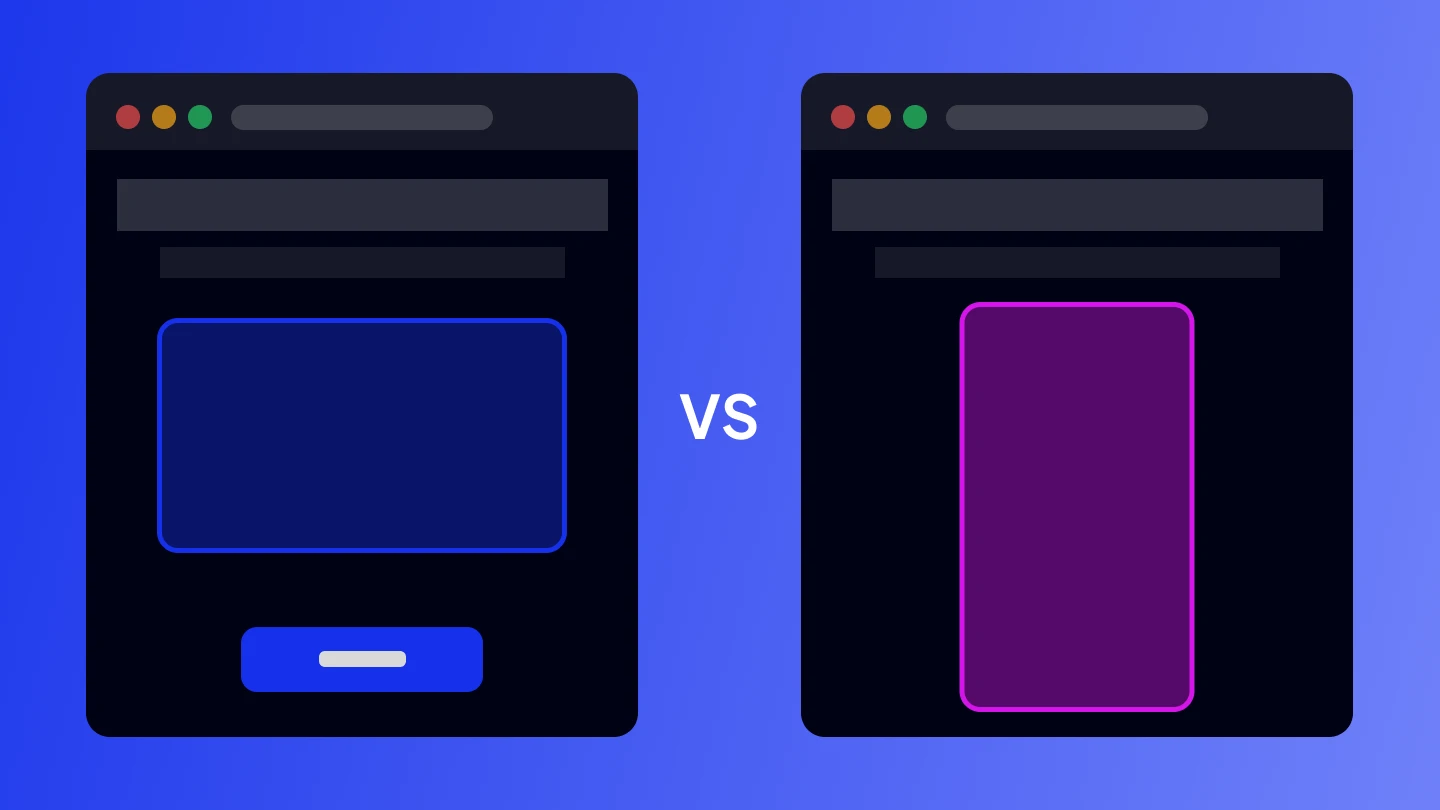

Could using a vertical VSL increase the conversion rate of your sales page?
This question is becoming more common among infoproduct creators, and that makes sense. Snapchat and Instagram have changed the way people consume video. Vertical format has become the everyday standard, and those who sell online are starting to wonder whether that should also change the way a VSL is produced.
The short answer is: it depends. But not in a vague way.
It depends on something very specific that you probably already have data to answer, and that’s exactly what this article will help you understand.
Why it’s worth thinking about your VSL format
For years, horizontal was an unquestioned standard.
That made sense: video was born in widescreen format, landing pages were designed for desktop, and most decisions were made in front of a computer.
That scenario has changed.
Worldwide, mobile devices now generate more than 62% of all global web traffic — and as of mid-2024, around 96% of internet users access the web via mobile phones.
That doesn’t mean all traffic to your landing page is mobile, but it does mean a significant portion probably is.
And there’s one data point that puts the issue into perspective: studies indicate that 94% of smartphone users hold their phones vertically while watching videos. When a horizontal VSL appears in that situation, the viewer has two options: rotate the phone or watch with a small player and black bars on the top and bottom. Most people don’t rotate it.
That doesn’t make horizontal the wrong choice. It makes it costly in terms of user experience, depending on who is watching and from where.
Also read: Video retention rate: what it is and how to improve it
The right question when choosing between a horizontal or vertical VSL
Most infoproduct creators ask, “Which format converts more?” That’s the wrong question, or at least an incomplete one.
The right question is: how will people arrive at your landing page?
The acquisition channel determines the type of device. And the device is what makes the VSL format relevant or irrelevant to the person watching. Here’s how that changes depending on your funnel:
Paid traffic from Instagram: the user is arriving on mobile. These are mobile-first consumption channels by nature. A landing page with a vertical VSL is more likely to deliver a smooth, frictionless experience.
Organic traffic from Google: the mix changes. More informational or commercial searches still have a relevant desktop presence, especially when the user is actively researching. In this case, horizontal makes more sense.
Direct links shared through bio, email, or WhatsApp: access is almost certainly mobile. The user clicked the link while browsing on their phone and will watch on their phone. Vertical delivers a much more natural experience in this case.
There is no universally superior format. There is the right format for your channel and your audience’s device.
What vertical format delivers in practice
When properly implemented, a vertical VSL on a mobile landing page has real advantages:
The video takes up almost the entire screen, with no black side bars
The person doesn’t need to rotate the phone or interact with the player
The experience feels immersive, similar to what they are already used to on social media
That reduces friction in the very first seconds, which are the most critical for retention.
But there is an important limitation that many people ignore: changing the video format without adapting the page layout does not solve the problem and may create new ones.
A vertical VSL placed on a landing page designed for desktop looks visually awkward and can hurt the page’s credibility.
Before changing the format, think about the surrounding context. Was the page designed for mobile? Does the CTA appear in the right place?
Vertical format only delivers on its promise when the page was built for it.
When to use horizontal and when to test vertical
With all that in mind, here is an objective criterion for that decision:
Use horizontal when:
Your landing page has mixed desktop and mobile traffic
The page is indexed on Google and can be found organically
Your audience has a broader or B2B profile, where computer access is still common
Test vertical when:
More than 80% of your traffic is mobile
The landing page is exclusive to a paid campaign and is not indexed
Your audience fits the profile of people who already consume a lot of vertical content daily
To find your percentage of mobile traffic, go to Google Analytics 4 and filter by device type.
How to test without re-recording everything from scratch
If you already have a VSL ready and want to understand whether it’s worth testing a vertical version, you can use a video editor to reframe the video for the new format. In many cases, there is no need to re-record it.
With both formats in hand, the next step is to measure.
Platforms like Panda Video let you run A/B tests directly in the player, comparing metrics such as play rate, retention rate, and completion rate between versions.
This data tells you far more accurately than any generic benchmark what works for your specific audience.
The format is not the problem. Misalignment is
What hurts conversion is using the wrong format in the wrong context.
If most of your audience arrives on mobile through ads or direct links, vertical deserves to be tested. If traffic is mixed or has a relevant desktop presence, horizontal is still the safest choice. What you can’t do is make that decision based on guesswork.
Regardless of your choice, Panda Video has all the features you need to increase the conversion of your sales video.
Try Panda Video for free with your content today.