Video Retention Rate: What It Is and How to Improve It


Video retention rate is one of the most honest metrics in video marketing. It doesn’t lie. It shows, with surgical precision, the exact moment you lost your audience’s attention — and the opportunity to convert.
So if you fill a live stream with 200 people but only 30 stay until the pitch, you don’t have a traffic problem. You have a retention problem.
In this article, you’ll understand what retention rate is, what makes people abandon a video, and most importantly, how to improve it depending on the format you produce.
How to calculate video retention rate
Retention rate is the average percentage of a video that viewers watch until the end.
In simple terms: of everything you published, how much did people actually consume?
The basic formula is:
Retention Rate = (Watch time ÷ Total video length) × 100
If your video is 10 minutes long and the average viewing time is 4 minutes, your retention rate is 40%.
But retention goes beyond a single average number. The best analytics tools display a retention graph over time — a curve that reveals exactly at which seconds or minutes people are dropping off.
That graph is where the gold is.
Why retention rate is one of the most important video metrics
Because it is directly connected to three things every content creator and infopreneur cares about:
1. Platform algorithms: On YouTube, retention is one of the main ranking signals. Videos with high retention are rewarded with more organic distribution.
2. Lead quality: Someone who watches 80% of a lesson or a VSL is far more qualified than someone who leaves in the first two minutes. Retention acts as a natural intent filter. The longer someone spends with your content, the more they trust you — and the closer they are to buying..
3. Conversion performance: A VSL with low retention rarely converts. The pitch usually appears after the midpoint of the video. If no one reaches that point, it doesn’t matter how good the product or offer is. The same applies to a product demo. If viewers drop off before seeing the main differentiator, the opportunity is lost.
For this reason, retention is not a vanity metric..
What is considered a good retention rate?
There’s no universal number. The benchmark changes depending on the video format, platform, and goal.
YouTube (content videos)
According to data from Retention Rabbit analyzing more than 75 YouTube niches between 2024 and 2025, the platform’s average retention rate is 23.7% — and only 1 in 6 videos (16.8%) surpass 50% retention.
This means videos reaching 50–60% retention perform significantly above average and tend to be widely distributed by the algorithm.
Of course, video length matters. The longer the content, the more natural it is for retention to drop proportionally — which doesn’t necessarily indicate poor performance.
VSLs (Video Sales Letters)
The benchmark is different here. A 30–60 minute VSL that keeps 30%–40% of the audience until the end can already perform very well — as long as the pitch is properly positioned.
What matters most is the retention curve. It shouldn’t drop too sharply too early.
Online classes and courses
For educational content hosted on platforms, the ideal retention rate is above 70% per lesson.
Sharp drops at specific moments often reveal where the explanation lost clarity or where the pacing became too slow.
Live webinars
Audience drop-off during a webinar is normal. The main concern is maintaining viewers during the transition to the pitch.
If you start with 300 attendees and reach the CTA with only 80, something in the middle needs to be reconsidered.
Product demonstrations
Demos are usually shorter and more objective videos.
Retention below 60% is already a warning sign that the content may be getting lost in unnecessary details. The most important thing isn’t hitting a magic number.
It’s understanding where the curve drops and what that means for your objective.
Why people abandon videos
Before talking about solutions, it’s essential to understand the problem.
Drop-offs are rarely random. They usually happen for predictable — and avoidable — reasons.
The first drop-off point typically happens in the opening seconds.
If a video starts with a long personal introduction, a generic opening, or no clear promise of what’s coming next, viewers leave before giving the content a chance.
The viewer needs to immediately feel that the video is relevant to them and worth their time.
When the promise exists but the pacing doesn’t sustain it, abandonment is simply delayed.
Long pauses, unnecessary repetition, and explanations that drag on too long slowly wear down attention until the viewer quits.
This becomes worse when there are technical problems, especially audio issues. Echo, noise, or unstable volume can break the viewing experience in a way editing cannot fix.
Finally, there are two structural mistakes that frequently appear:
CTA placed at the wrong moment
Lack of perceived relevance
Asking for action before delivering value — or after losing the audience — wastes the right moment.
And if at any point the viewer feels the content doesn’t solve the problem they came with, abandonment becomes immediate.
Understanding these patterns is the first step to rewriting your script — either literally or in how you structure each type of video.
How to improve retention rate by video type
There is no single formula.
Retention strategies vary significantly depending on the format — which is why it’s worth addressing each one separately.
What works in an online class may not work in a VSL, and what holds attention in a webinar has little to do with what makes a demo convert.
How to improve retention in VSLs
The VSL is probably the format where retention has the most direct impact on financial results.
A VSL that loses the audience before the pitch simply won’t convert — regardless of how much was invested in traffic.
Hook within the first 30 seconds: Start with the pain point, the promise, or a provocative statement. Avoid long introductions. The viewer needs to feel immediately that the video is about them.
Make the promise clear from the beginning: Explicitly state what the viewer will learn, gain, or understand by watching until the end. This creates psychological commitment to the experience.
Maintain narrative pacing: Long VSLs need consistent pacing. Use internal hooks — small promises throughout the video that encourage viewers to keep watching. Example:
"And in a moment I’m going to show you what changed everything for me."
Avoid long pauses: Silence and hesitation break the flow. If it’s a talking-head video, the editing needs to be agile. If it’s an audio VSL with slides, the pacing of narration is everything.
Strategic CTA placement: Place the main CTA at the peak emotional moment, usually after social proof and before the guarantee section. Also include a secondary CTA after the guarantee for viewers who needed extra convincing.
Use visual elements to sustain attention: On-screen text, highlights, scene changes, and visual elements break monotony and redirect focus.
On Panda Video, features such as the Fake Progress Bar can create a perception of progress for the viewer, encouraging them to continue watching even in longer videos.
How to Improve Retention in Online Classes and Courses
In courses, retention is directly tied to the learning experience. When students feel they are progressing, they keep watching. When they feel they are wasting time, they drop off — and sometimes never return.
Clear chapter structure: Each lesson should have a clear beginning, middle, and end. Explain what will be covered, develop the topic clearly, and close with a summary or transition to the next lesson. This reduces student anxiety and keeps engagement high.
Didactic language without tangents: Going off-topic breaks the learning flow — even if the information is interesting. If something isn’t directly related to the lesson’s objective, it’s better saved for supplementary material.
Practical examples and visual resources: Theory without application gets tiring. Alternating between conceptual explanations and practical examples keeps the brain more engaged. Well-designed slides, screen demonstrations, and simple animations make a big difference.
Ideal lesson duration: For most course formats, lessons between 8 and 15 minutes tend to achieve better retention. Lessons that are too long cause fatigue, while very short lessons may feel superficial. The ideal duration delivers the necessary content without unnecessary additions or omissions.
The impact of “resume where you left off”: When students know they can pause and return exactly where they stopped, the barrier to starting a lesson becomes much lower. Platforms like Panda Video offer this feature natively, and it has a direct impact on course completion rates.
In addition, Panda Video Tutor allows students to ask questions directly about the video content, increasing engagement and reducing the feeling of learning alone.
Read also: AI Chatbot: How to Add It to Your Online Course
How to Improve Retention in Webinars
Webinars have a unique challenge: audience drop-off is expected and progressive. The real question isn’t “How do we prevent people from leaving?” but rather:
“How do we keep the maximum number of relevant viewers until the pitch?”
Warm up the audience before starting: The first minutes of a live webinar are critical for creating presence and anticipation. Interact with the chat, ask simple questions, and present the agenda clearly. This builds a sense of belonging from the beginning.
Encourage interaction throughout the event: Polls, chat questions, or prompts asking participants to reply with a word or emoji. Interaction breaks passivity and activates the participant’s commitment to the event.
Avoid long blocks without engagement: More than 15–20 minutes of uninterrupted presentation can significantly reduce the audience. Break the content into smaller blocks and alternate them with engagement moments.
Structure the transition to the pitch: This is the most delicate part. The transition must feel natural. Build the narrative so the offer becomes the logical conclusion of everything presented. Announce the transition in advance, for example: "In the next few minutes, I’ll show you how you can continue this journey with my help."
How to Improve Retention in Product Demos
Product demos are technical videos with a very clear goal: to show that the product solves the problem. When well executed, they are extremely effective.
When poorly structured, they become long, confusing, and lose the viewer before showing what matters.
Get straight to the point: No one wants to watch three minutes of introduction before seeing the product in action. Start by showing what will be demonstrated and, if possible, show the final result right away to create anticipation.
Show the problem before the solution: Before presenting the feature, show the pain point it solves. Example: "You’ve probably wasted time trying to do X manually — here’s how this works with Panda Video." This is much more engaging than simply clicking through menus.
Avoid unnecessary menus and clicks: Every second of irrelevant navigation is an opportunity for drop-off. Edit ruthlessly. If a step can be shortened during recording, shorten it..
Use narration to guide attention: In demos, viewers don’t always know where to look. The narrator’s voice acts as a guide — directing attention, explaining context, and giving meaning to what’s happening on screen.
How to Track Your Video Retention Rate
Knowing retention matters is the first step. Knowing where to find the data is what allows you to act.
On YouTube
YouTube Analytics provides a retention graph for every video.
To access it:
Go to YouTube Studio and open the Content tab
Select the video you want and go to Analytics
Open the Engagement section
There you will see the average view duration and the average percentage viewed.
On Panda Video
For those hosting videos on Panda Video, the Analytics dashboard provides detailed retention data for each video.
In the Retention tab, you can view both a graph and percentage showing how long viewers stay on each video. You can also configure Target Retention / Pitch Retention.
This allows you to define a key moment in the video (such as the CTA or pitch) and track, both in numbers and percentages, how many users reached that point.
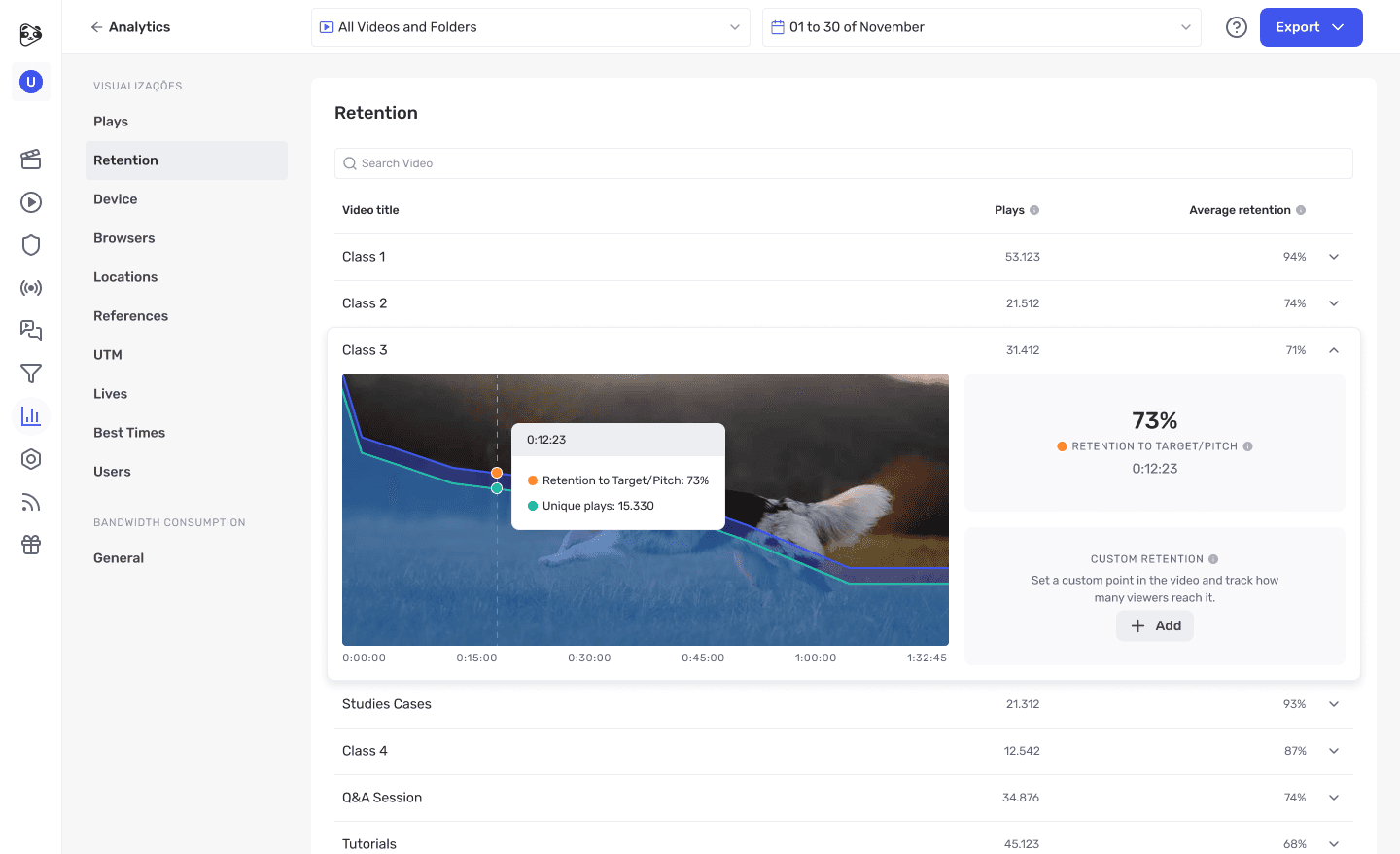
This is especially useful when analyzing the copy of a VSL and identifying exactly where the audience drops off before reaching the offer.
Panda Video Analytics also gathers data on:
Plays
Devices
Geographic location
Traffic sources
UTMs
and more
All data can be exported in PNG, PDF, or CSV formats.
Retention Rate and Conversion: What’s the Relationship?
The relationship is direct:
The longer someone spends watching your video, the warmer that lead becomes — and warm leads convert more.
A VSL with 25% retention isn’t just performing poorly in a single metric.
It is delivering a cold lead to the CTA — someone who left before understanding the offer, before seeing social proof, and before perceiving the product’s value.
Optimizing retention means optimizing the persuasion process.
In this context, features such as Panda Video’s Smart Autoplay help reduce the friction at the start: the video begins automatically at the right moment without requiring any action from the viewer.
The Fake Progress Bar creates a perception of advancement that encourages viewers to continue watching.
And the Analytics dashboard provides the data needed to test, adjust, and continuously improve.
Read also: How to Improve VSL Video Results on Panda Video
Conclusion: Retention Reflects the Quality of Your Communication
At its core, retention rate answers a single question: are you able to keep people’s attention?
It does not measure only the technical quality of the video. It measures the clarity of your message, the strength of your hook, the relevance of your content and the pacing of your narrative. It is a thermometer of how well you are communicating with your audience.
And the good news is that it can be improved. With the right data, the right adjustments and the right tools.
If you want to start tracking and improving the retention of your videos with real data, Panda Video offers everything you need: detailed Analytics, Video Funnel, Tutor, Fake Progress Bar and much more — all in a platform built for those who take video seriously.
Discover Panda Video and start transforming your retention into conversion.