How to Create an Online Mentoring Program: Complete Guide


You already have students, followers, or clients. You’ve already proven that your knowledge has value. Now the question comes to mind: “Should I create an online mentoring program?”
I won’t answer that for you, but one thing is certain: you’re at the best possible moment to start a mentoring program.
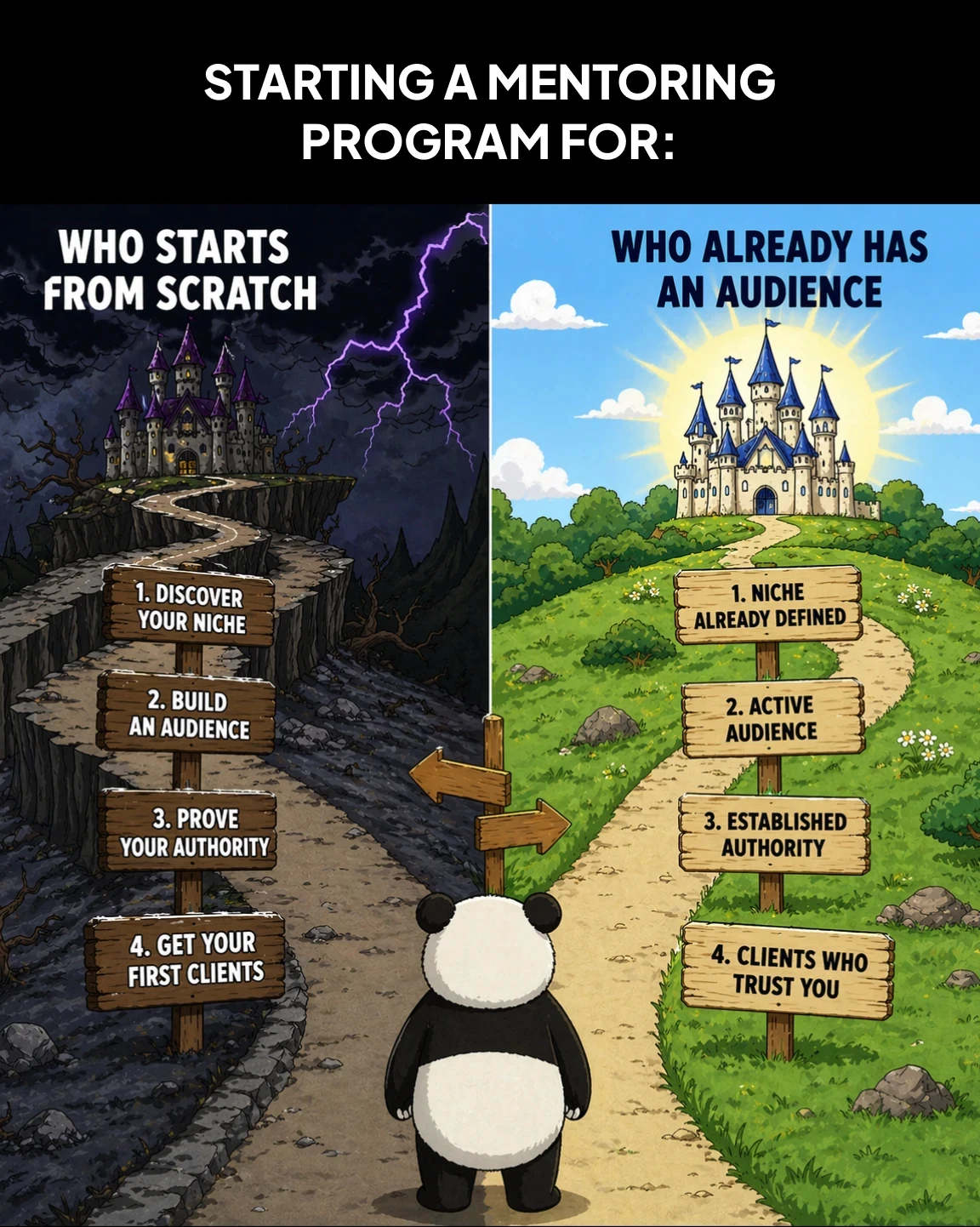
Those starting from scratch need to find a niche, build an audience, and establish authority before selling anything. You’ve already done all that. The hardest asset to build in the digital market is already in your hands. What’s left is structuring the right offer to monetize it at a higher level.
In this guide, you’ll learn how to create an online mentoring program from scratch, focusing on those who already have a client or student base and want to add a high-ticket product to their business.
What is an online mentoring program (and how it differs from your course)
An online mentoring program is a guided experience where an expert helps mentees solve specific problems and accelerate results.
Unlike an online course, which delivers standardized content to many students, mentoring focuses on practical application, with individual or group guidance.
Before moving forward with your mentoring program, it’s important to understand this difference. Many digital creators confuse these formats, and this positioning mistake directly impacts conversion and pricing.
A course is an asynchronous, scalable, structured product. The student buys it, accesses recorded lessons, and learns at their own pace.
Mentoring, on the other hand, offers continuous guidance. The mentor analyzes the student’s context, identifies mistakes, suggests improvements, and directs decisions. The client isn’t buying knowledge—they’re buying clarity and faster results.
This directly impacts pricing. While courses usually range between $60 and $300, mentoring programs start at $400 and can exceed five figures depending on the niche (Banco de Palestrantes).
But that doesn’t mean one replaces the other. In practice, they complement each other. Mentoring is the next step for those who have already gone through your course.
Online Course | Mentoring | |
|---|---|---|
Format | Asynchronous, recorded | Live sessions + materials |
Personalization | Same for everyone | Tailored to each mentee |
Average ticket (BR) | $60 to $300 | $400 to $4,000+ |
Creator’s time | One-time production | Ongoing commitment |
Scalability | High | Low (higher in groups) |
Perceived value | Content | Transformation |
Step 1: Identify who in your audience fits the mentee profile
Not every student or client fits the mentee profile. This distinction is your first filter.
Course students vs. service clients
Someone who bought your course has shown interest in the topic but is still in the learning phase. Some of them will want to go further when they get stuck or when results take too long.
Those who have already hired your services, on the other hand, have a different profile: they’re used to paying for results, already trust your work, and tend to be more committed. This audience usually converts better into mentoring because they clearly see the value of ongoing support.
Signs someone is ready for the next step
You don’t have to guess. Just pay attention to behaviors already present in your audience:
People who message you asking if you offer one-on-one support
Students who rewatch lessons multiple times and still come back with specific questions
Clients who ask to continue working together after a contract ends
People who have implemented what they learned and want to reach the next level
These are the easiest mentees to convert because the sale is already halfway done. They just need a clear offer.
Step 2: Choose the right format for your reality
There’s more than one way to structure a mentoring program, and the right choice depends on how much time you have, the level of personalization you want to offer, and the price you intend to charge.
One-on-one mentoring
This format has the highest perceived value. You dedicate exclusive time to one person, adapt everything to their case, and deliver an experience no course can replicate.
The downside is obvious: limited capacity. You only have so many hours per week, and every hour sold is your time. To make this sustainable, the price must reflect that exclusivity.
It’s the ideal format for beginners because it requires less structure and provides clarity on what works before scaling.
Group mentoring
Here, a group of mentees goes through the same journey together. Sessions are collective, questions are shared, and part of the value comes from networking among participants.
The individual price is lower than one-on-one, but revenue per hour can be higher. It’s the natural path for those who want to scale without multiplying their time.
The risk is reduced personalization. To compensate, many mentors combine group sessions with individual touchpoints: a monthly check-in or direct messaging for specific questions.
Hybrid model
This combines both approaches: group sessions for shared content and context, plus periodic one-on-one sessions for personalized guidance.
It’s the most common format among mentors with an established audience who want to maximize experience without sacrificing scale.
One-on-One | Group | Hybrid | |
|---|---|---|---|
Personalization | Maximum | Low | High |
Scalability | Low | High | Medium |
Price per person | High | Medium | High |
Revenue potential | Medium | High | High |
Best for | First cohort | Scaling | Established audience |
Step 3: Structure your method
This is the step that creates the most uncertainty for first-time mentors. It feels like you need to “invent” something. But the truth is different: you probably already have a method—you just haven’t formalized it yet.
Point A to Point B
Every successful mentoring program has a clear journey: the mentee starts with a specific problem (point A) and leaves with a concrete result (point B). Your role is to design the most efficient path between those points.
If you’ve already helped clients or students achieve results, that path already exists in your mind. Now you just need to document it: what steps, in what order, and which practical exercises at each stage.
A simple framework is the “problem, action, result” model per module:
What problem does the mentee need to solve at this stage?
What concrete action will they take?
How will you know they’ve completed it before moving forward?
Number of sessions and cadence
There’s no single formula, but some patterns work well:
Short programs: 4 to 6 weeks, 1 session per week. Ideal for specific, well-defined outcomes.
Mid-length programs: 2 to 3 months, biweekly sessions. Balances depth and implementation pace.
Long programs: 6 months or more, monthly or biweekly sessions. For broader transformation journeys.
The right duration allows enough time for implementation. Without implementation, there’s no result. Without results, there are no testimonials for future cohorts.
Supporting materials
A mentoring program doesn’t have to rely only on live sessions. Additional materials increase perceived value and help mentees absorb content between sessions. Common examples:
Recommended readings or summaries
Recorded lessons for recurring concepts
Spreadsheets and templates
Session recordings for later review
This last point is more important than it seems. Research shows that access to recorded sessions helps reinforce learning (Panopto).
Step 4: Set up your delivery infrastructure
The technical setup is where many mentoring programs fail. The mentor creates an excellent method, sells well—and then problems appear: sessions without organized recordings, materials scattered across Google Drive folders, and students downloading and sharing content with others.
Tools for live sessions
For real-time meetings, the most commonly used tools are Zoom and Google Meet. Both work well for one-on-one and group mentoring with up to a few dozen participants.
Zoom has an advantage in recording features and room control, which is especially relevant for group mentoring.
The problem with improvised storage
A very common mistake is using Google Drive or YouTube to store session recordings and mentoring video materials.
The issue with Google Drive is that anyone with the link can download the file, regardless of sharing settings. You don’t have real control over who accesses it, from where, and for how long.
YouTube solves loading speed but creates another problem: the content is exposed on the platform, with no real protection against downloads through external tools.
For those selling a high-ticket product, this lack of control is a serious issue. A client who paid $1,000 for your mentoring program shouldn’t access content in the same environment as someone who never purchased anything.
Read also: Panda Video ou YouTube: When should you use each?
Content protection and professional experience
Video hosting platforms built for creators and mentors solve this natively. With Panda Video, for example, you get access to a set of features designed specifically for delivering high-value content:
Download protection and DRM Watermark: your videos cannot be downloaded, and each access can include a dynamic watermark tied to user data (name, email, ID). If content leaks, you know exactly where it came from.
Domain Control: the player only works on authorized domains, preventing unauthorized embedding on external websites.
Offline app: mentees can download lessons through the Panda Video app to watch offline, but the files remain restricted to the app. They cannot export or share the content outside the platform.
Playlists: organize session recordings in a logical sequence so mentees can easily find everything in the right order without needing your guidance.
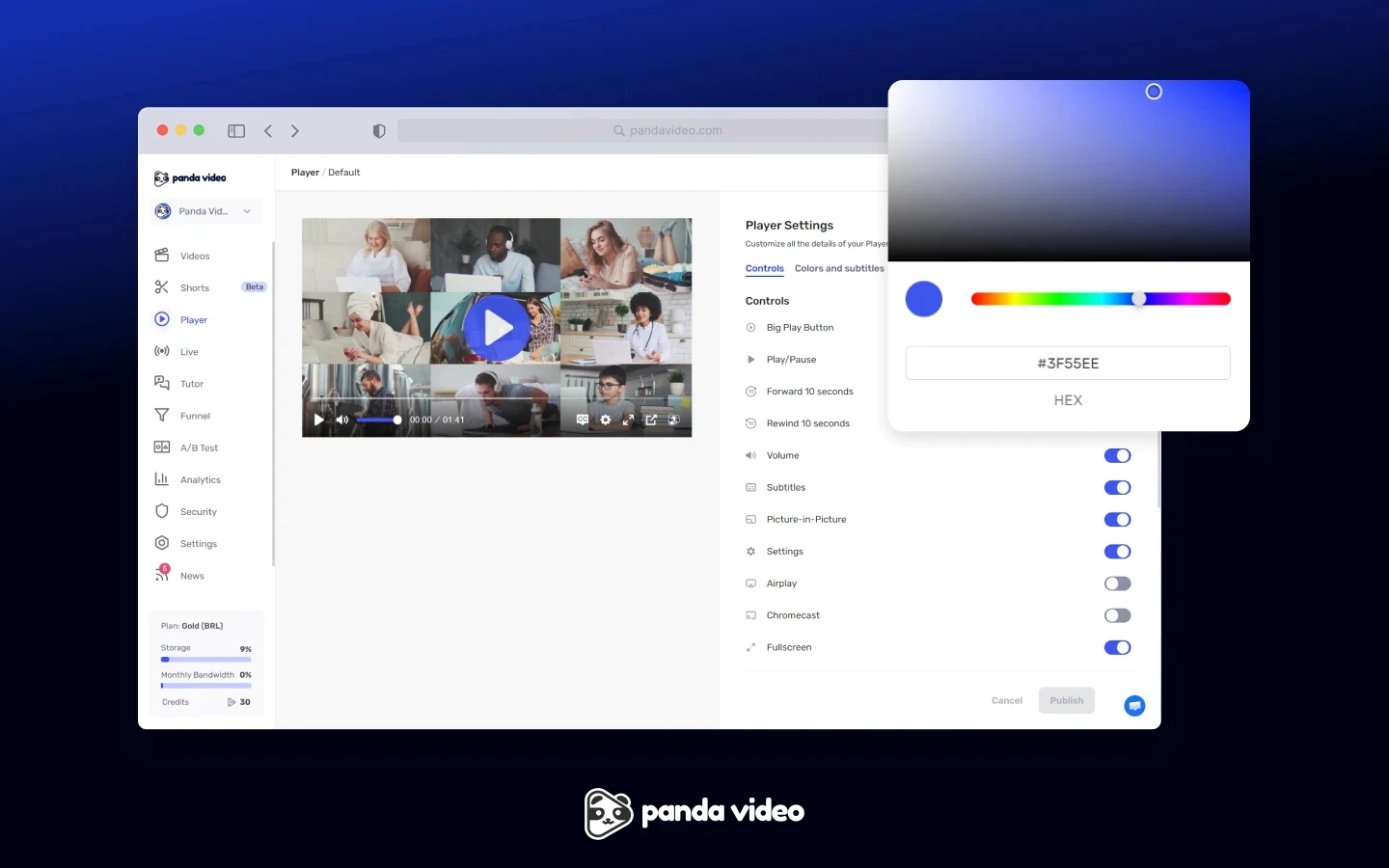
Customizable player: adjust colors, logo, and visual identity so the experience aligns with your brand from the very first access.
All of this impacts both security and user experience. A clean player with your branding and well-organized content conveys far more professionalism than a Drive link or an unlisted YouTube video.
Step 5: Price your mentoring based on results, not time
The classic mistake is calculating the price of your mentoring by multiplying hours by an hourly rate, as if it were a standard service.
Mentoring is not about selling time. It’s about selling transformation—and transformation has a completely different value.
How to price based on results
The right question isn’t “how much is my time worth per hour?” It’s “how much is the result of my mentoring worth to my mentee?”
If you teach someone how to launch their first digital product and they generate $4,000 in the first month, what is the value of the guidance that made it possible? Certainly more than a few hours of consulting.
A practical way to anchor your price is to research what other mentors in your niche charge for similar outcomes and position your offer based on the value of the result—not the number of hours included.
Entry-level vs. high-ticket mentoring
For your first cohort, it makes sense to start with a lower price than what you intend to charge in the future. This is because:
You’re still testing your method and journey
You need testimonials and success stories
The perceived risk is higher without a proven track record
Once you have documented results and real testimonials, your price can increase.
Stage | Profile | Suggested price |
|---|---|---|
First cohort | No proven track record, validating the method | $400 to $600 |
Growing | Initial testimonials, refined method | $600 to $1,500 |
Established authority | Documented case studies, warm audience | $1,500 to $4,000+ |
Just try to avoid these common mistakes:
Charging too little out of fear of not selling and later resenting the time invested
Offering too many payment installments without considering default risks
Not having a clear cancellation and refund policy before opening enrollment
Step 6: Present your mentoring program to those who already know you
Selling to your existing audience is much easier than selling to strangers. Trust is already built. What’s missing is the right offer, at the right time, communicated the right way.
The sales landing page
Before anything else, you need a page that clearly communicates what the mentoring program is, who it’s for, what the mentee will achieve, and how it works. This page should include:
The promised transformation (point A to point B) in the headline
Description of format, duration, and what’s included
Testimonials or social proof (even from previous services)
A FAQ section addressing main objections
A clear CTA for application or a free strategy session
The free strategy session
For higher-ticket mentoring, the sales process rarely happens in one click. You can offer a free strategy session: a 30-minute call where you understand the prospect’s situation, demonstrate your expertise, and present your mentoring program as the solution.
This is essentially a diagnostic call. You ask questions, listen, identify where the person is stuck, and then show how your mentoring solves that specific problem.
For your audience, this approach is even more effective because context already exists. You’re not introducing yourself—you’re expanding what you can offer.
How to nurture your audience before opening enrollment
Before launching your mentoring program, it’s worth creating a warm-up period. You can:
Send emails highlighting results from advanced students
Talk about it on social media and open Q&A boxes
Build curiosity within YouTube videos or your course content
Host a free webinar where you deliver value and introduce the mentoring at the end
The goal is that when enrollment opens, your most qualified audience members are already close to making a decision.
Conclusion: Mentoring starts before the first session
Creating an online mentoring program doesn’t have to be complicated. What requires attention is the structure behind delivery: a clear method, a professional infrastructure, and an offer that communicates real value.
For those who already have a student or client base, the path is even shorter.
And when someone joins your mentoring program, the experience matters as much as the method. Easy access to recordings, protected content, and a branded player all contribute to the perceived value that justifies a higher price.
Panda Video was built for this scenario: secure hosting with DRM Watermark, domain-based content protection, an offline app for students, playlists to organize sessions, and a fully customizable player. Everything you need to deliver a high-level mentoring experience.
Test Panda Video for free and increase the security and professionalism of your mentoring programs.