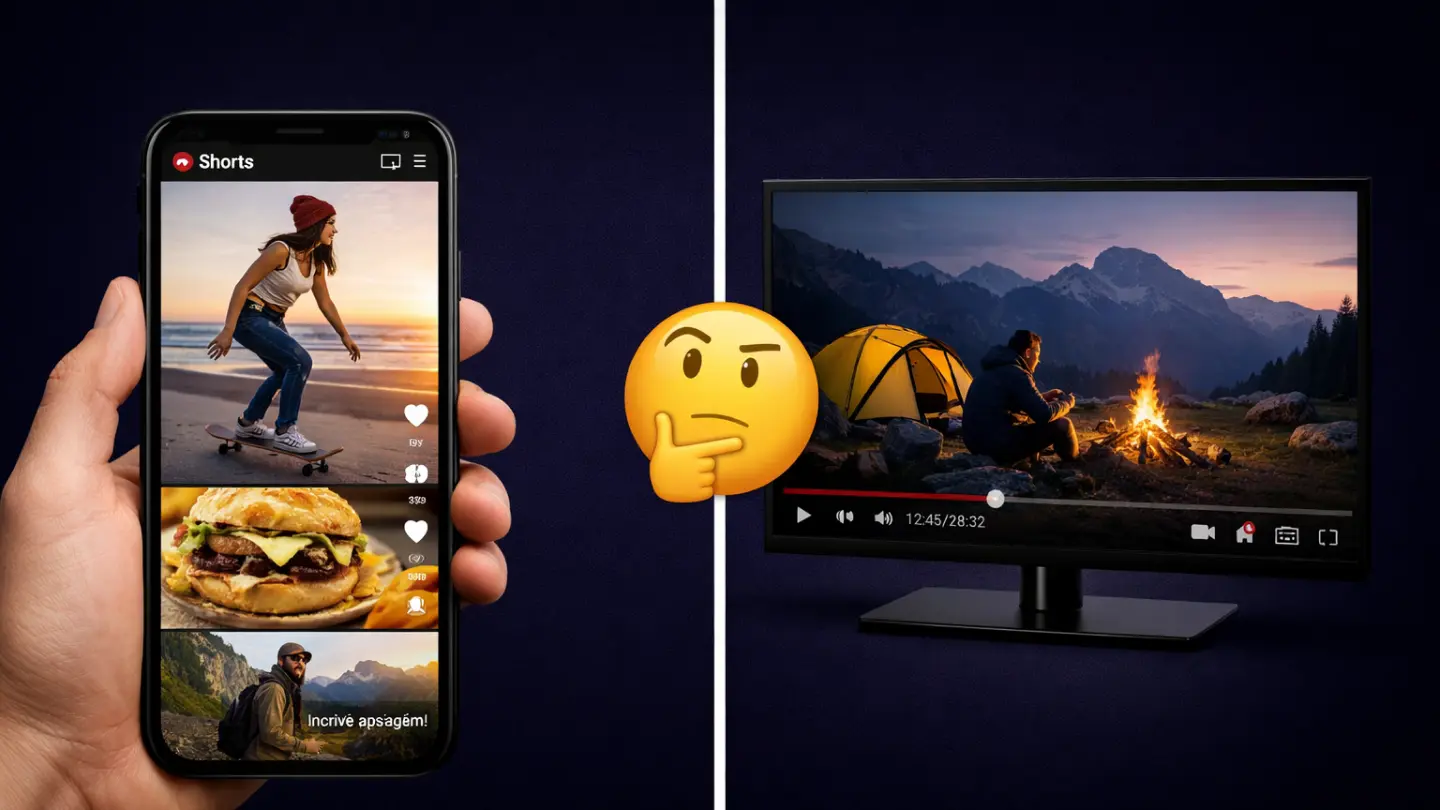

If you run a YouTube channel, you’ve probably considered publishing vertical videos but worried they might confuse the algorithm and hurt your main content. You’re not alone.
This is one of the most common concerns among creators who have already built a loyal audience with long-form videos.
The good news is that YouTube itself has already addressed this topic. In this article, you’ll clear up this doubt and learn how to make the most of both formats without compromising your channel’s growth.
What YouTube officially says about mixing Shorts and long-form videos
YouTube has publicly stated that posting Shorts and long-form videos on the same channel does not harm a channel’s performance.
In interviews and official videos from the Creator Insider channel, platform executives have explained that internal analyses compared channels posting only long-form content with channels combining both formats. The result? Channels that also produced Shorts were growing faster.
Todd Sherman, Director of Product for Shorts, reinforced that the two formats operate with different algorithmic dynamics: with long-form videos, viewers actively choose what to watch; with Shorts, they discover content while scrolling the feed (Search Engine Journal).
Rene Ritchie, a YouTube creator liaison, explained that the platform does not evaluate performance at the channel or creator level, but rather at the level of each individual video and topic. If one Short doesn’t perform well, it doesn’t affect the distribution of your next long-form video (The Leap).
In practice, this means the algorithm doesn’t “confuse” the two audiences. It understands that someone might enjoy your Shorts without necessarily wanting to watch your 20-minute videos—and vice versa.
Why this doubt is so common among creators
If YouTube has already clarified that there’s no problem, why are so many creators still worried?
The answer lies in the metrics. When you start posting Shorts on a channel that previously only had long-form videos, some channel averages change. The profile of new subscribers changes. And for creators who closely monitor Analytics, this can feel like a warning sign.
But it’s important to understand how the algorithm actually works. YouTube evaluates each video individually, not the overall channel average. Just like channels that run many livestreams often show higher average watch time without affecting regular uploads, channels that publish many Shorts may show lower averages without harming their long-form videos.
In most cases, what happens is not an algorithmic penalty. It’s a shift in the audience composition that catches creators by surprise. And that’s where the real challenges can begin.
When Shorts can actually hurt your channel
Saying Shorts don’t harm your channel doesn’t mean every strategy will work. There are scenarios where short-form content can create more problems than solutions.
The first risk is attracting an audience that isn’t interested in your long-form videos. Shorts reach people who are in rapid-consumption mode, scrolling their feed looking for quick entertainment. If these viewers subscribe because of a Short but never watch your long-form content, you may end up with a subscriber base that doesn’t engage with your main videos.
The second risk is lack of thematic consistency. If your long-form videos focus on digital marketing strategies but your Shorts feature random memes or unrelated trends, your channel loses identity. The algorithm may have a harder time understanding who to recommend your content to.
The third risk involves vanity metrics. Shorts can generate impressive spikes in views. But views alone don’t mean real growth. If they don’t convert into engaged subscribers, those views are just nice-looking numbers on your dashboard.
Notice that none of these issues come from the format itself. They are all the result of a poorly planned strategy. Creators who understand this difference can use Shorts to benefit their channel instead of harming it.
Read also: Video retention rate: what it is and how to improve it
The strategy that works: using Shorts as a gateway to long-form videos
The secret to combining Shorts and long-form videos on the same channel lies in a simple concept: use Shorts as a discovery engine and long-form videos as a retention engine.
Here’s how it works: the Short grabs attention, raises a question, or delivers a quick insight. The long-form video expands on the topic, delivers deeper value, and turns a casual viewer into a loyal follower.
This isn’t just speculation. The data supports it. According to the YouTube Culture & Trends Report published by Think with Google, 59% of Gen Z uses short-form videos to discover content that they later watch in long-form format.
The same report highlights the case of Manual do Mundo (Manual of the World) to illustrate this dynamic.
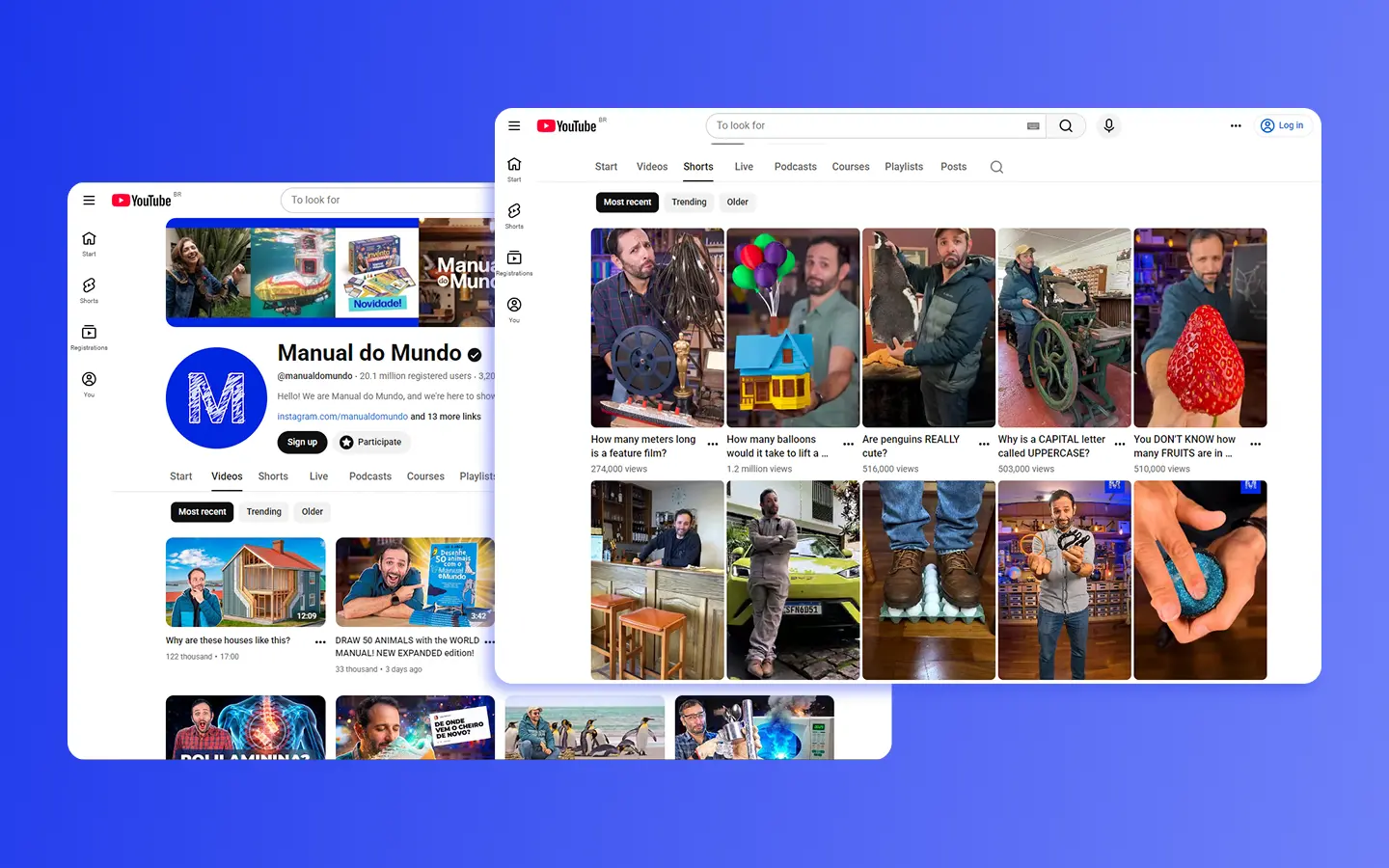
The Brazilian channel with 20 million subscribers, known for long-form science and experiment videos, began producing Shorts with their own style: quick experiments, practical tips, and visual curiosities. The result was a significant acceleration in new subscriber growth, especially from the Shorts feed.
To apply this strategy to your own channel, three principles make a big difference:
Thematic consistency: the topic of the Short should be directly related to the universe of your long-form videos. If your channel is about vegan cooking, for example, a Short could show a quick recipe that complements a more detailed lesson.
Curiosity-driven hook: Shorts work best when they open a question or trigger a reaction that only the long-form video answers. Example: “The biggest mistake that destroys your YouTube engagement” (Short) → “How to optimize your channel to grow in 2025” (long-form video).
Consistent publishing: social media algorithms reward consistency. Posting 10 Shorts in one day and disappearing for two weeks doesn’t work. Ideally, distribute your clips throughout the week to keep your channel active and the algorithm fed.
Do I need to create a separate channel for Shorts?
This is another common question. And in most cases, the answer is no.
YouTube itself recommends that creators group channels around audiences who enjoy the same type of content.
Todd Beaupré, YouTube’s Director of Discovery, summarized it like this:
“Same audience? Same channel. Different audience? Different channel.”
According to him, creators such as MrBeast—who initially separated Shorts into different channels—have already returned to publishing everything on their main channel (vidIQ).
How to turn long-form videos into Shorts strategically
If you already produce long-form content such as classes, livestreams, webinars, or podcasts, the raw material for Shorts already exists. The challenge is extracting the best moments without spending hours editing manually.
This is where artificial intelligence becomes a powerful ally. AI tools can analyze a full long-form video and automatically identify the most impactful moments. Instead of watching a 60-minute recording searching for clips, you receive ready-to-use suggestions in minutes.
The Panda Video Shorts feature works exactly like this.
You upload a long video (or paste a YouTube link), and the AI generates multiple clips optimized for platforms like YouTube Shorts, TikTok, and Reels. Each clip receives a virality score indicating which ones have the highest potential reach.
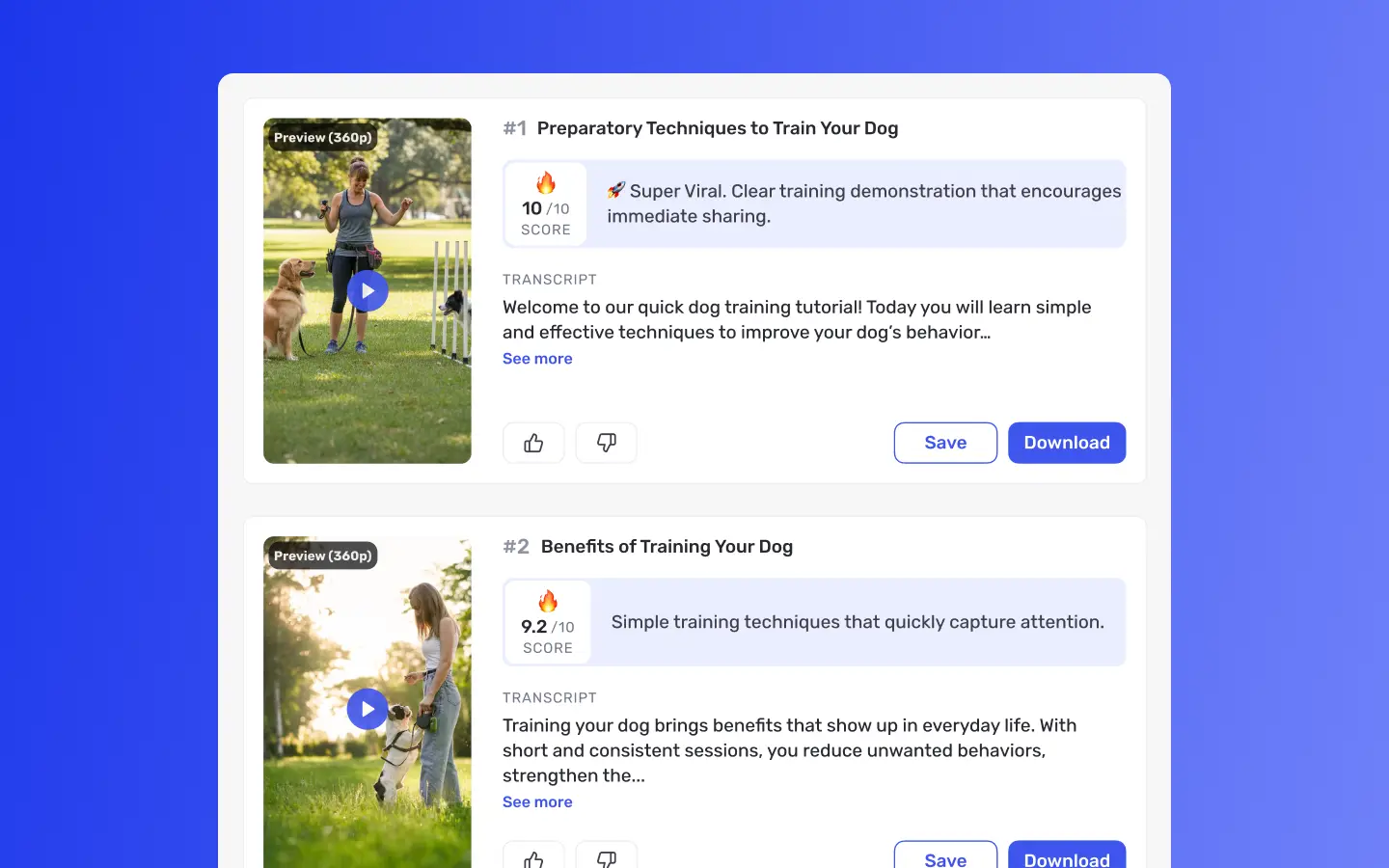
The result is a full content calendar created from material you’ve already produced—without needing to record anything new.
Beyond saving time, this approach also guarantees the thematic consistency we discussed earlier.
If you want to learn more, I prepared another article explaining how to create AI clips ready to post.
Shorts and long-form videos are not enemies — they are allies
Let’s recap what we’ve covered:
YouTube has already confirmed that posting Shorts and long-form videos on the same channel does not harm the algorithm.
Data shows that channels combining both formats tend to grow faster.
Strategically planned Shorts act as a gateway to long-form videos.
Random Shorts without thematic connection can attract a misaligned audience.
YouTube wants creators to use both formats. Data shows that audiences naturally move between them. And with AI tools like Panda Video Shorts, turning long-form videos into optimized clips is no longer a time-consuming task.
Want to start transforming your long-form videos into Shorts ready to go viral? Discover Panda Video and start creating AI-powered clips today.