Persuasion Techniques: What They Are + 20 Video Examples
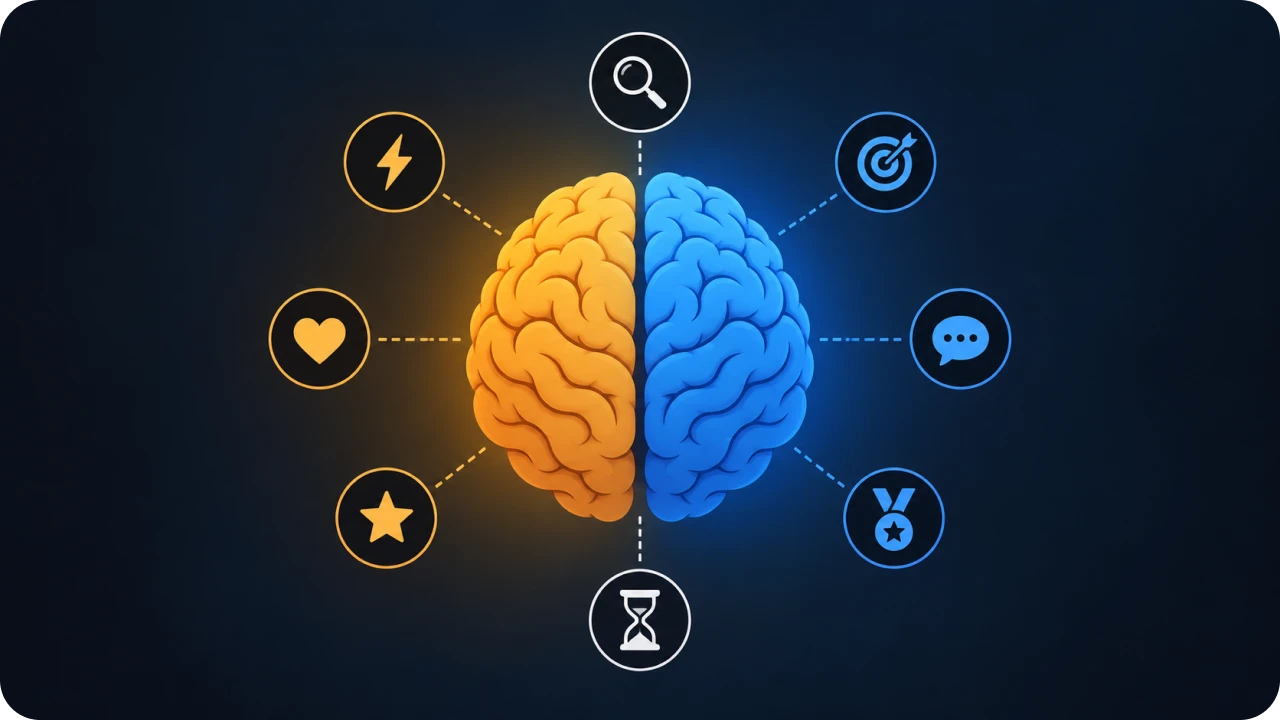

Used by marketers everywhere, persuasion techniques have the power to influence decisions through the right choice of words and visual stimuli.
In this article, you will learn what persuasion techniques are and how to use them in videos for social media, ads and VSLs, across 20 varied examples.
What are persuasion techniques?
Persuasion techniques are signals that make the brain reach a decision without stopping to analyze it. They work because, to save effort, the brain follows ready-made rules, like trusting experts or doing what the majority does.
In marketing, they are used to win the audience's attention, build trust and encourage the purchase. Marketers treat "persuasion techniques", "persuasion tactics" and "marketing psychology" as near synonyms, and most of the techniques below were organized by Robert Cialdini in Influence: The Psychology of Persuasion (1984). In school, "persuasive techniques" usually refers to Aristotle's three appeals (ethos, pathos and logos); this article covers the ones used in marketing.
This happens because the brain has no way to analyze every decision from scratch.
Daniel Kahneman, in Thinking, Fast and Slow (2011), describes two modes of thinking. System 1 is fast, automatic and emotional, and System 2 is slow, analytical and lazy.

Most buying decisions run through System 1, and persuasion techniques work precisely because they speak to it, offering signals the brain has already learned to follow without stopping to analyze.
How a persuasion technique is activated
A persuasion technique can be activated both by what is said or written and by what the person perceives while watching the video. In practice, that means combining elements like speech and on-screen text with visual resources like images and the pace of the cuts.
Take social proof, for example. It can appear explicitly in a line like "Over 3,000 students have taken this course", but it can also be perceived visually by showing results, testimonials or real student examples. When words and image reinforce the same message, the technique tends to become clearer and more convincing.
That combination is backed by Dual Coding Theory, proposed by Allan Paivio in 1971. The idea is that verbal and visual information are processed by distinct systems and, when they work together, they can make understanding and memorization easier.
20 persuasion techniques and how to use them in video
The 20 techniques below are grouped by the job they do in a video: grabbing attention, building connection, building belief, raising the value of the offer and driving the decision.
1. Curiosity
What it is: the urge to know what is missing. When the video opens a question, people stay to hear the answer.
Why it works: George Loewenstein (1994) described curiosity as an information gap people feel driven to close.
In words: "The mistake that makes students quit before lesson 3".
In visuals: a thumbnail that shows the reaction and hides the cause.
Example on YouTube: a guitar teacher publishes "The chord that trips up almost every beginner", with a thumbnail of a tense hand and a red X, without revealing the chord. The answer only comes mid-video. On your own page, the player's custom thumbnail plays the same role.
Read next: Video click-through rate: what it is and how to improve it
2. Surprise
What it is: the reaction to the unexpected. A pattern break grabs attention before the person even understands what they are seeing.
Why it works: tracking the gaze of people watching videos, Laurent Itti and Pierre Baldi (2009) found it went most often to the moments where something unexpected happened.
In words: a claim against common sense, like "Stop posting every day".
In visuals: a hard cut, an abrupt change of setting or an unexpected sound in the first second.
Example on Reels: a personal trainer opens the video knocking over a stack of dumbbells, with the text "You don't need these to build muscle". Only then does she talk about bodyweight training.
3. Novelty
What it is: the pull of what has not been seen yet. A new method draws more attention than a repeated promise.
Why it works: Nico Bunzeck and Emrah Düzel (2006) showed that a brain region tied to dopamine reacts specifically to new images.
In words: "The method I started using this year".
In visuals: the new tool or result working on screen.
Example in an ad: an accountant selling a finance course for freelancers opens by photographing a receipt, and the spreadsheet fills itself in. The explanation comes afterward.
4. Anticipation
What it is: the expectation of what comes next, which keeps people watching or brings them back.
Why it works: in a study by George Loewenstein (1987), people preferred to wait three days for a kiss from their favorite movie star rather than get it right away. The wait itself is pleasurable.
In words: "In the next video, I'll show you the spreadsheet I use".
In visuals: a countdown, a "part 1 of 3" card, a scheduled premiere.
Example on YouTube: a nutritionist publishes the series "Meal prep for the week" and ends each episode with a clip of the next one: "In part 2, the full $150 menu for five days".
5. Pain and pleasure
What it is: the drive to escape a problem or reach a result. Showing the pain usually draws more attention than only promising the gain.
Why it works: Daniel Kahneman and Amos Tversky (1979) showed that losing hurts more than winning the same amount pleases. That is loss aversion.
In words: "You record the lesson, post it, and almost nobody watches to the end".
In visuals: a frustrated expression, a falling graph and, then, the relief.
Example in an ad: a language teacher opens with "Studied Spanish for 5 years and still freeze on the first question?" written over the image of someone silent on a video call. Since the pain is on screen, the ad works even on mute.
6. Liking
What it is: the tendency to trust people who look like us.
Why it works: it is one of Robert Cialdini's six principles (1984): we say yes more easily to people we like and identify with.
In words: the niche's own expressions and everyday problems.
In visuals: phone camera, real setting, unpolished behind-the-scenes.
Example on Stories: a home baker who sells a sourdough course films in her own kitchen, at 6 AM, in a flour-dusted apron. Her students, who also bake at home, recognize themselves there in a way a studio video never allows.
7. Belonging
What it is: the desire to be part of a group and take part in what it does.
Why it works: by social identity theory, from Henri Tajfel and John Turner (1979), part of who we are comes from the groups we belong to.
In words: the community's name and inside expressions, like "if you're one of us, you know".
In visuals: student faces, the community's colors and symbols.
Example on YouTube: a running channel calls its subscribers the "5K Crew", opens every video with the same catchphrase and closes with photos of members' races. For whoever already feels part of the crew, the paid course is the natural next step.
8. Common enemy
What it is: pointing at what keeps the audience from the result, like a method, a belief or an old way of doing things.
Why it works: it also comes from Tajfel and Turner (1979). A shared adversary strengthens the sense of group between you and the viewer.
In words: "It's not you. It's the way you were taught".
In visuals: the old method crossed out on screen, side by side with yours.
Example in a VSL: an SAT essay tutor opens showing the "memorized template" crossed out in red and explains why it caps the score at average. The student stops blaming themselves and opens up to the new method.
Read next: What is a VSL and how it works
9. Storytelling
What it is: a story with a beginning, a conflict and a turn, which people follow to the end to see how it finishes.
Why it works: Melanie Green and Timothy Brock (2000) showed that people absorbed in a story tend to adopt its ideas and look for fewer flaws in it. They called it narrative transportation.
In words: "In 2021, I had 37 students and was ready to quit".
In visuals: old photos, screenshots from back then, the real places of the story.
Example on YouTube: a wedding photographer tells, in 20 minutes, the story of the first wedding he shot, which went wrong. The technical tips appear inside the story, not as a list.
Read next: Video script: how to create great lessons from scratch
10. Authority
What it is: the tendency to trust whoever demonstrates command of the subject.
Why it works: in Stanley Milgram's experiments (1963), 65% of participants obeyed a researcher to the very end, even while uncomfortable with what they were doing.
In words: a specific credential, like "I work with 400 clinics every month". "Renowned expert" convinces no one.
In visuals: a work setting, a stage, press appearances.
Example in an ad: a dentist selling a clinic management course shows "15 years in practice, 400 clinics served" before the 5 seconds when YouTube unlocks the "Skip" button.
11. Social proof
What it is: the tendency to follow what others do. If people like me bought it and liked it, the purchase feels safer.
Why it works: in Solomon Asch's experiments (1951), about 75% of participants went along with the group's wrong answer at least once, even with the right one in front of their eyes.
In words: a testimonial with name and result, like "Juliana, from Austin, went from zero to 12 clients in four months".
In visuals: results screenshots, real comments, a student counter.
Example in a VSL: in a paid ads course, retention drops around minute 8, when the method explanation begins. That is where a testimonial screenshot enters at the corner of the player.
In the player: this is done with Mini Triggers, which display an image or GIF over the video at the time range you choose.
12. Transformation
What it is: showing the before and after so the person can see the possible result.
Why it works: through contrast, which makes the change clear in seconds, with no explanation needed.
In words: "From 0 to 100 students in 90 days".
In visuals: a split screen with the same person, the same angle and the same light. If anything changes, the comparison looks staged.
Example on Reels: an interior designer opens with the empty room on one side, decorated on the other, and the text "$800, no drilling". The rest of the video shows the process.
13. Simplicity
What it is: the preference for the path that looks easy. The simpler it looks, the more people believe they can do it.
Why it works: in Adam Alter and Daniel Oppenheimer's review (2009) of cognitive fluency, what is easy to process feels more true and more trustworthy.
In words: "3 steps", "without showing your face".
In visuals: numbered steps appearing on screen.
Example in an ad: a social media manager shows, in 15 seconds, how to create a post on the phone: pick the template, swap the text, export. Whoever watches leaves believing they can do it too.
14. Commitment and consistency
What it is: the tendency to stay consistent with what we have already done. Whoever takes a small step tends to take the next one.
Why it works: in Jonathan Freedman and Scott Fraser's study (1966), residents who agreed to display a small road safety sticker were far more likely to accept, weeks later, a large sign on their lawn. It is the foot-in-the-door technique.
In words: "Comment SPREADSHEET and I'll DM it to you".
In visuals: an arrow to the comments, a poll or question sticker.
Example on Reels: a financial advisor closes the video with "Comment SPREADSHEET and I'll send it in your DMs". The comment is the first yes. In the DMs come the spreadsheet and the invitation to the free class.
15. Reciprocity
What it is: the will to give back when someone gives us something useful.
Why it works: in Dennis Regan's study (1971), people who received a soda from a stranger later bought twice as many raffle tickets from him.
In words: "I'm giving you the whole method in this video".
In visuals: the material on screen (spreadsheet, template, checklist), with the link in the description.
Example on YouTube: a lawyer publishes a complete class on contracts for freelancers, with a template to download. The course offer only appears at the end, after the person has already received something they will use.
16. Anchoring
What it is: the tendency to judge a number by the first one that appears. The same price looks high or low depending on what came before.
Why it works: Amos Tversky and Daniel Kahneman (1974) showed that even the number drawn on a roulette wheel influenced the estimates made right after.
In words: "A consulting project like this costs $3,000", before presenting the price.
In visuals: the full price crossed out, the offer's items added up on screen.
Example in a VSL: in an Excel course, the expert adds up the value of each part of the offer ($1,791 in total) before showing the $497 price. Each value needs a real basis, like the price you have actually charged for that part.
Read next: Direct response: the marketing principle behind VSLs
17. Guarantee
What it is: the promise to give the money back, which removes the risk from the decision.
Why it works: through loss aversion (Kahneman and Tversky, 1979), the fear of losing the money weighs more than the desire for the result.
In words: "Try it for 30 days. If it's not for you, you get 100% of your money back".
In visuals: a guarantee badge visible through the entire offer.
Example in a VSL: the expert announces the guarantee together with the price, and the badge stays on screen until the end.
In the US, there is no federal right to return an online purchase, so a real money-back guarantee is a genuine differentiator. The counterpart is that the FTC requires guarantee terms to be clear and honored (Guides for the Advertising of Warranties and Guarantees, 16 CFR Part 239).
18. Exclusivity
What it is: the value of having access to something not everyone has.
Why it works: Robert Cialdini (1984) treats exclusivity as a form of scarcity. Restricted information feels more valuable.
In words: "This video is only for people who watched the full class".
In visuals: a "members only" screen, the name of the closed cohort.
Example in a retargeting ad: a mentor for real estate agents creates a video shown only to people who watched half the VSL and did not buy. It opens with "If you're seeing this, it's because you watched my presentation" and answers the most common objections.
Read next: Retargeting for VSLs: 4 segments you need to advertise to
19. Scarcity
What it is: the tendency to value what is limited. The scarcity technique only holds when the limit is real.
Why it works: in the study by Stephen Worchel, Jerry Lee and Akanbi Adewole (1975), the same cookies looked more desirable in a jar with 2 units than in a jar with 10.
In words: "Last 12 spots in this cohort".
In visuals: a spots-left counter that actually changes.
Example on Stories: a physical therapist opens 30 mentorship spots and updates the count throughout the day, with a screenshot of the sales dashboard. When the spots run out, the cohort closes.
20. Urgency
What it is: the pressure of a deadline. It is the persuasion technique tied to time: if in scarcity what runs out is the quantity, in urgency it is the time.
Why it works: for Cialdini (1984), the deadline is a form of scarcity applied to decision time.
In words: "This offer ends Friday at 11:59 PM ET".
In visuals: a buy button that appears with the deadline announcement.
Example in a VSL: the button stays hidden until minute 24, when the expert announces a bonus valid until Friday. Deadline and button show up together.
In the player: the button at the exact second is set up with CTA buttons in the player. For the button outside the video, see how to create a sales page with a time delay.
Recap: the 20 persuasion techniques in words, in visuals and by format
# | Technique | In words | In visuals | Best format |
1 | Curiosity | A title that opens a question without answering it | Thumbnail that shows the reaction and hides the cause | YouTube |
2 | Surprise | A claim against common sense | Hard cut or unexpected sound in the first second | Instagram (Reels) |
3 | Novelty | "The method I started using this year" | New tool or result on screen | Video ad |
4 | Anticipation | "In the next video, I'll show you..." | Countdown, "part 1 of 3" | YouTube |
5 | Pain and pleasure | The audience's pain written on screen | Frustration, then relief | Video ad |
6 | Liking | The niche's own expressions | Phone camera, real behind-the-scenes | Instagram (Stories) |
7 | Belonging | Community name, catchphrase | Faces, colors and symbols of the community | YouTube |
8 | Common enemy | "It's not you, it's the way you were taught" | Old method crossed out on screen | VSL |
9 | Storytelling | The turnaround story, with dates and numbers | Old photos and screenshots from back then | YouTube |
10 | Authority | A specific, verifiable credential | Work setting, stage, press | Video ad |
11 | Social proof | Testimonial with name and result | Results screenshots, student counter | VSL |
12 | Transformation | "From 0 to 100 students in 90 days" | Split screen with before and after | Instagram (Reels) |
13 | Simplicity | "3 steps", "without showing your face" | Numbered steps appearing on screen | Video ad |
14 | Commitment and consistency | "Comment SPREADSHEET" | Arrow, poll sticker | Instagram (Reels) |
15 | Reciprocity | "I'm giving you the whole method" | Material delivered on screen | YouTube |
16 | Anchoring | A reference value before the price | Full price crossed out, offer added up | VSL |
17 | Guarantee | Return window and terms | Guarantee badge during the offer | VSL |
18 | Exclusivity | "Only for people who watched to the end" | Members-only screen | Video ad (retargeting) |
19 | Scarcity | "Last 12 spots" (true) | Spots counter that actually changes | Instagram (Stories) |
20 | Urgency | "Ends Friday at 11:59 PM ET" | Button with a deadline appearing at the offer | VSL |
Perception techniques in the player: what only a VSL can do
In social and ad formats, the technique lives inside the content. In a VSL, the player itself becomes a persuasion channel, because it controls what the viewer perceives outside the video, like the progress, the sound, the notices and the button.
Progress: why a faster progress bar keeps people watching
A loyalty card with stamps already filled in gets completed faster than an empty one (Kivetz, Urminsky and Zheng, 2006), and the progress bar applies that effect, moving faster at the start of the video.
Commitment: the click to unmute
Whoever clicks to unmute the video has already made a small commitment to it, the foot-in-the-door effect (Freedman and Fraser, 1966). Smart Autoplay starts the video muted and turns that click into the first yes.
Visual reinforcement where retention drops
Mini Triggers display social proof, notices and callouts over the video at the exact seconds where attention usually slips.
The button that shows up at the offer
The button that appears at the right time concentrates the decision at the moment the viewer is most convinced, right after the full offer. CTA buttons in the player show up exactly then, at the minute you set.
Read next: How to set up your VSL to convert more
Is there one persuasion technique that works best?
No single persuasion technique works best in every case. What matters is the format and how well the audience already knows you. In a Reel for people who have never seen you, curiosity and surprise make them stop scrolling. In a VSL for people already on your sales page, a guarantee, scarcity and urgency make them buy.
Beyond the format, order also counts. A technique only works if the person is still watching when it appears. That is why attention techniques open the video, connection and belief techniques fill the middle, and offer and decision techniques close it.
How to measure the result of a persuasion technique
Measuring the effectiveness of a persuasion technique means tracking metrics aligned with the job it does in the video's journey (attention at the start, connection and belief in the middle, and offer or decision at the end), plus the format used.
For attention techniques, like curiosity or surprise, look at retention in the first 3 seconds, the hook rate in ads and the thumbnail click-through rate (CTR) on YouTube.
For connection and belief-building techniques, like storytelling, authority and social proof, analyze the retention curve through the middle minutes, along with engagement like comments and saves on Instagram.
For offer and decision techniques, like scarcity, urgency and guarantee, track the CTA button click rate and the final sales conversion. In VSLs, retention analytics let you follow that curve second by second, and the guide on how to read your retention rate helps with the detailed reading of those graphs.
Conclusion
Persuasion techniques are the brain's decision shortcuts, activated simultaneously by words and visual elements. The video format defines which ones perform best, while each channel's metrics reveal their real effectiveness. From this point on, the focus becomes entirely practical.
In a VSL, that interaction happens inside the player. Progress bar, Mini Triggers and a CTA button at the moment of the offer turn perception techniques into configuration, with no need to re-edit the video. Meet the Panda Video player for VSLs and try it free for 14 days.